
Automated Citation & Reference Checker
Automated citation checking for academic papers.
Even careful authors make honest mistakes — wrong DOIs, outdated preprints, missed retractions. And AI-assisted writing is making fabricated references more common. RefRunner checks every reference in your paper against Crossref, OpenAlex, Google Books, and OpenLibrary and flags anything that can't be verified. The whole list, in minutes, in your browser.
Looking to verify employment or personal references? RefRunner is specifically for academic citations in research papers — not HR reference checks.
No account needed to try it — check our sample or upload your own paper, free and right in your browser.
A free account adds 50 lookups a day, saved reference lists, and free months when you refer colleagues.
📱 On a phone? Create a free account now and your reference lists will be waiting when start working on your paper.
The problem is getting worse
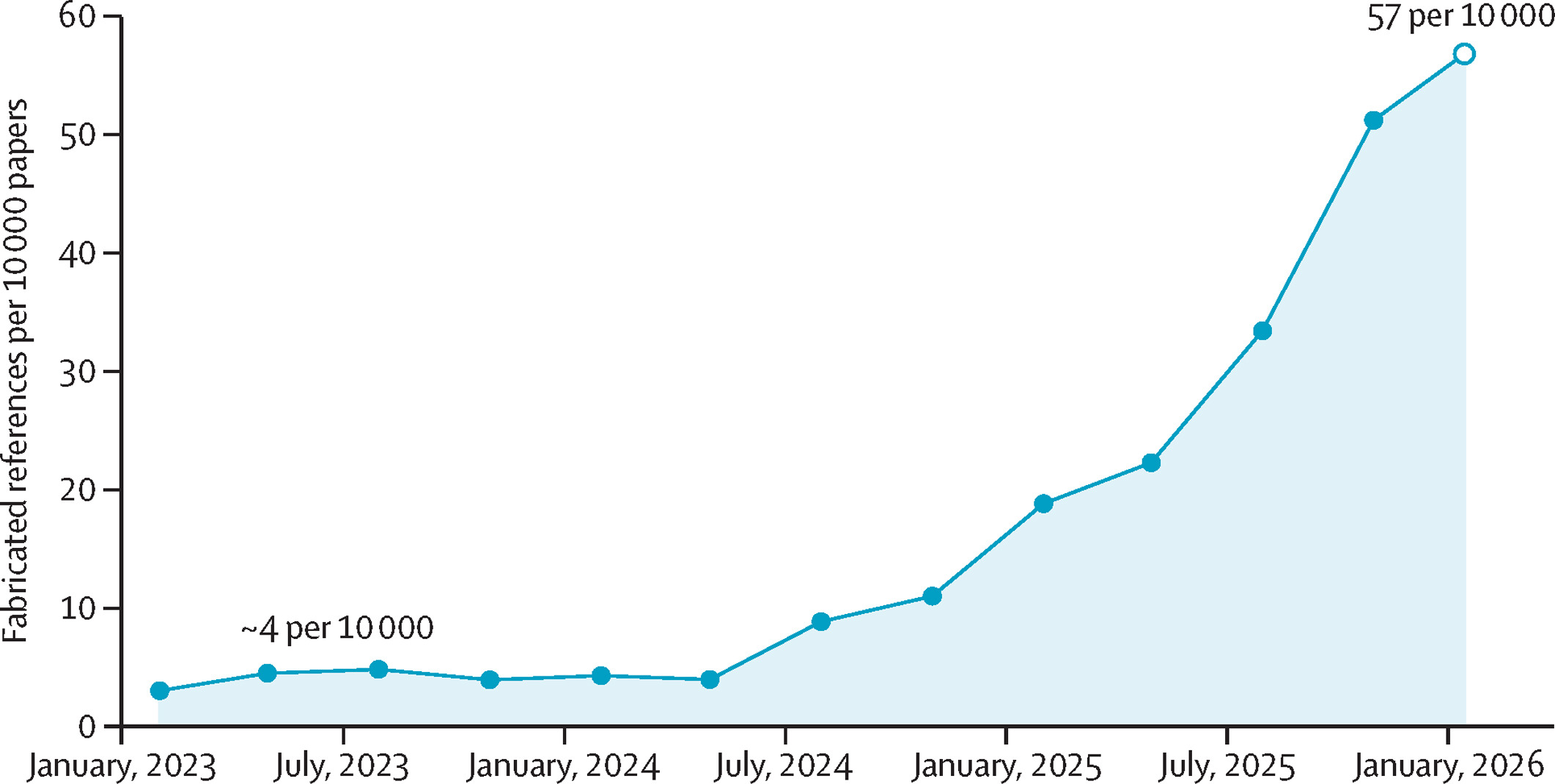
A 2026 Lancet study audited 2.5 million biomedical papers and found fabricated references rising sharply since 2024. The authors conclude that "automated reference verification can close this gap" — but until now, no tool has made it fast enough to fit into an editorial or authoring workflow.
What automated citation checking catches
Wrong metadata
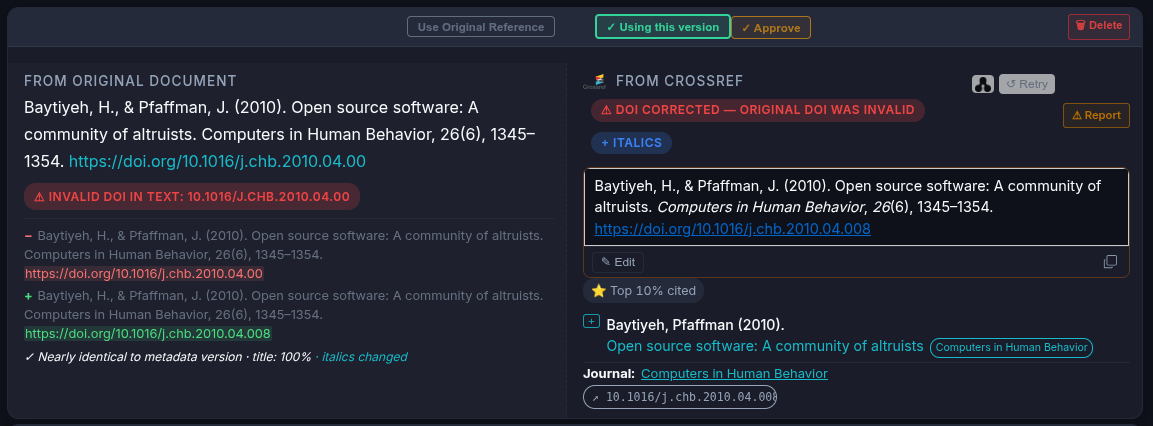
Truncated DOIs and metadata errors, caught instantly.
An author dropped the last character of a DOI — an easy, honest mistake. RefRunner flags the discrepancy, shows you the corrected version side-by-side with your original, and makes it easy to confirm the fix.
Missing DOIs
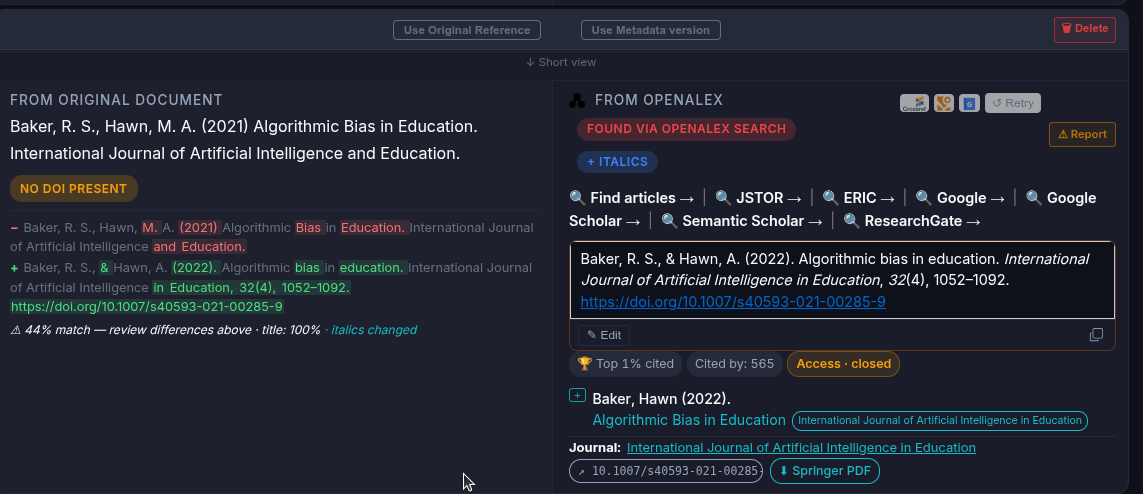
References without DOIs? RefRunner finds them.
Google Scholar makes it easy to grab a reference but often skips the DOI. RefRunner searches Crossref and OpenAlex, finds the match, and reformats the reference correctly — including sentence capitalization required by APA.

Preprint updates
Preprints cited before publication get updated automatically.
Authors rarely recheck DOIs they've already validated every time they revise and resubmit. RefRunner catches preprints that have since been published with a new year, volume, issue, and page numbers.
Retracted papers
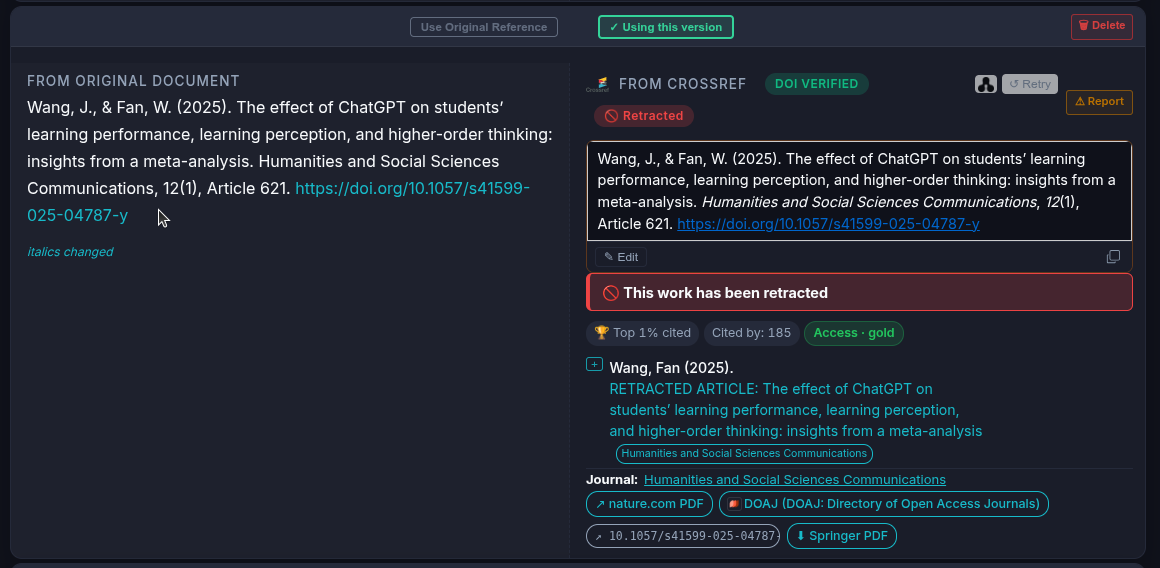
Retractions are easy to miss. RefRunner doesn't miss them.
An editor may not be attuned to every sub-field covered by a journal. RefRunner checks retraction status on every lookup against live data — not a static database — and makes the warning impossible to overlook.
How it works
Paste or upload your reference list
Paste references directly, drag in a Word document, or drop individual PDFs. RefRunner parses everything automatically.
Every reference is checked automatically
RefRunner looks up each DOI, finds missing ones, checks for retractions, and flags mismatches between your text and the authoritative record. Typically done in under 5 minutes for a full paper.
Review and export
Each proposed change is shown side-by-side with your original. Accept or reject, then download a corrected reference list or an updated Word document in your target citation style.
What RefRunner checks
DOI Verification
Every DOI in your reference list is verified against Crossref. Wrong ones are flagged; missing ones are found.
Retraction Detection
Checks live retraction status on every reference — not a static database. A retracted paper is never silently passed.
Preprint-to-Publication Updates
Detects when a preprint has been formally published and fills in the volume, issue, page numbers, and correct year.
Citation ↔ Reference Matching
Upload your manuscript and RefRunner highlights every in-text citation that lacks a matching reference, and every reference not cited.
Any Citation Style
Export in APA 7, MLA 9, Chicago, or any of 9,000+ CSL styles — the same formatter used by Zotero.
Nothing Leaves Your Browser
Your manuscript is never uploaded to a server. All processing is local; the only external calls are to public academic databases.